



Most renters are not really asking whether they can have wallpaper. They are asking whether it will come off.
Good peel and stick does, and the difference between a wall that peels away cleanly and one that takes the paint with it comes down to three things. The adhesive, which should let you slide a panel into place and release without residue. The material, where a matte paper or woven fabric hangs straighter and reads more like real wallpaper than shiny vinyl. And the print, because you will look at it every day. Below are the brands worth buying, with sizes, prices and sample costs taken from each brand's own site in October 2026.
The Best Peel and Stick Wallpaper Brands
Katie Kime
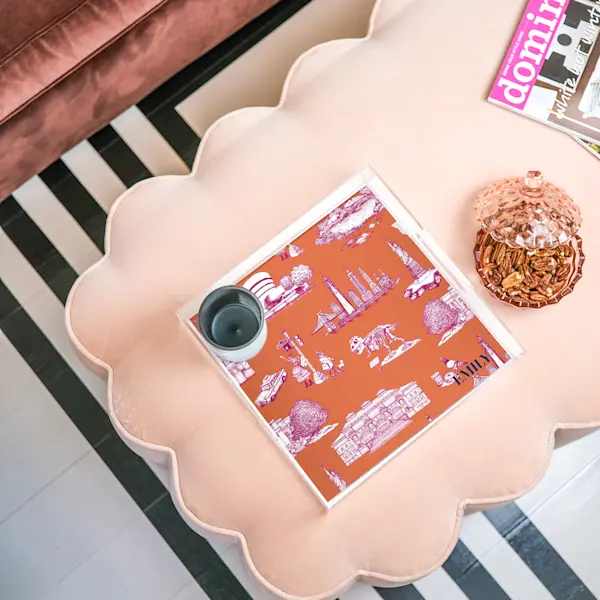
Our prints are hand-illustrated, then printed in-house in Austin for each order: city toiles with real landmarks, cheetah and leopard, stripes, palms. Panels are 24 inches wide in 48, 96 and 144 inch lengths, from $48 to $75 for the shortest and $134 to $215 for the longest, depending on the design. The paper is PVC-free with a slight woven texture and a matte finish. Small samples are $5 and large are $20, and your first 3 small samples are free with code SAMPLES, once per customer. Because every order is printed for you, wallpaper cannot be returned, so start with samples. The Daily Beast named us one of the best places to buy wallpaper online. See the full peel and stick collection.
Chasing Paper
Modern, artist-driven panels, including collaborations with Meredith Kinney, Ariel Okin and New Hat Projects. Panels are 2 feet wide in 4, 8 or 12 foot lengths, about $45, $90 or $125. Samples are $6. The material is a self-adhesive poly-woven fabric the brand calls water resistant and washable, and it is made in the USA.
Tempaper
One of the original peel and stick brands, sold in rolls rather than panels: 20.5 inches wide by 16.5 feet for a single (about $65) or 33 feet for a double (about $130). Samples are $8. It is vinyl printed with water-based inks, wipes clean with a damp cloth, and is made in the USA. There are designer lines too, the largest from Jeremiah Brent.
Spoonflower
A marketplace where independent designers upload patterns and every order is printed on demand. The selection is enormous and quality varies by designer, so it suits someone hunting a very specific pattern. Rolls are 2 feet wide in 3, 6, 9 or 12 foot lengths, and a 2 by 1 foot sample is $9. The paper is PVC-free with a woven linen texture. Spoonflower describes its peel and stick as best for short-term use, up to about a year.
Wallshoppe
Known for collaborations with Sarah Jessica Parker, Nathan Turner and Clare V. Panels are 26 inches wide in 4.5, 9 or 12 foot lengths, $58, $136 or $174. Samples are $7, plus $10 shipping. The paper is PVC-free and printed in California, and the brand suggests treating removal as one-time use.
WallPops
The budget pick, from York Design Group. Most rolls are 20.5 inches by 18 feet and run about $40 to $60, with $5.99 samples. They are designed to come off in full strips without sticky residue.
Renting? Three Rules
Check the lease first. Most say nothing about removable wallpaper, but if yours mentions wallpaper at all, get the landlord's yes in writing. It protects the deposit.
Then test. Put a sample somewhere hidden, leave it 48 hours, and peel it off. Older or flat paint is the most likely to lift.
Then start small. One accent wall behind the bed or sofa takes a handful of panels and changes the whole room.
How to Install It
Clean the wall and let it dry completely; freshly painted walls need about 30 days to cure. Measure the height, choose the panel length that covers it with a little to spare, and draw a straight line with a level where the first panel goes, because walls and ceilings are rarely true.
Peel back the top foot of backing, line the panel up with your mark at the ceiling, and press it on. Pull the backing down slowly while smoothing from the center out. Overlap or butt each new panel to match the pattern (ours overlap by 1/4 inch), then trim the excess at the ceiling and baseboard with a sharp blade.
Is It Worth It?
For renters, yes. It is one of the few ways to change a room without risking a deposit. For owners, it earns its keep on accent walls, powder rooms, closets and the backs of shelves. Skip it in a steamy full bathroom, on heavily textured walls, or anywhere with hard afternoon sun.
Order a few samples, tape them up, and look at them morning and night. The right one usually picks itself.