There’s a version of every bathroom that stops people in their tracks. Most people spend considerable time and money perfecting their living rooms and bedrooms, while the bathroom gets a fresh coat of paint at best and a new towel set at worst. Usually, the easiest upgrade involves wallpaper. Not because it’s enormous or expensive, but because someone made a decision in there that most people hesitate to make anywhere else in the house.
Bathroom wallpaper is one of the highest-impact, most underutilized moves in interior design. The room is small, the walls are the focal point, and guests are guaranteed to notice. We draw every print by hand, from real travels and a love of bold color, and bring the same care to your walls that a great stylist brings to a wardrobe.
If you’ve already decided you want to spruce up your home with bathroom wallpaper, this guide will help you make the right call on print, material, and installation so you end up with something you love rather than something you tolerate.
Why Bathrooms Are The Best Room To Wallpaper
The hesitation most people feel about bathroom wallpaper usually comes down to two things: moisture and commitment. Both are valid concerns, and both are more manageable than they seem once you understand what you’re working with.
The real reason bathrooms reward wallpaper so well is scale. A small room with a bold print feels intentional rather than overwhelming. You’re not trying to live inside the pattern the way you might in a bedroom or living room. Instead, you’re passing through, letting you catch glimpses and appreciate the details every time you step inside. That dynamic gives you permission to try prints that might feel too much anywhere else in the house, and to pull them off beautifully.
Powder rooms in particular are a designer's favorite for exactly this reason. There’s no shower, no direct moisture, and zero reason to hold back. When you invite guests over, a powder room with bold wallpaper is often the first thing they compliment about your home.
Peel-And-Stick Wallpaper For Bathroom: A Renter-Friendly Game Plan
Renters and commitment-shy decorators no longer have to sit out the wallpaper conversation. Peel-and-stick wallpaper has changed the way people approach temporary spaces, offering the full visual payoff of traditional wallpaper without the permanence or the hassle of professional installation. If you’ve been holding off on wallpapering your bathroom for practical reasons, this format removes most of those obstacles.
It Goes Up Without The Mess
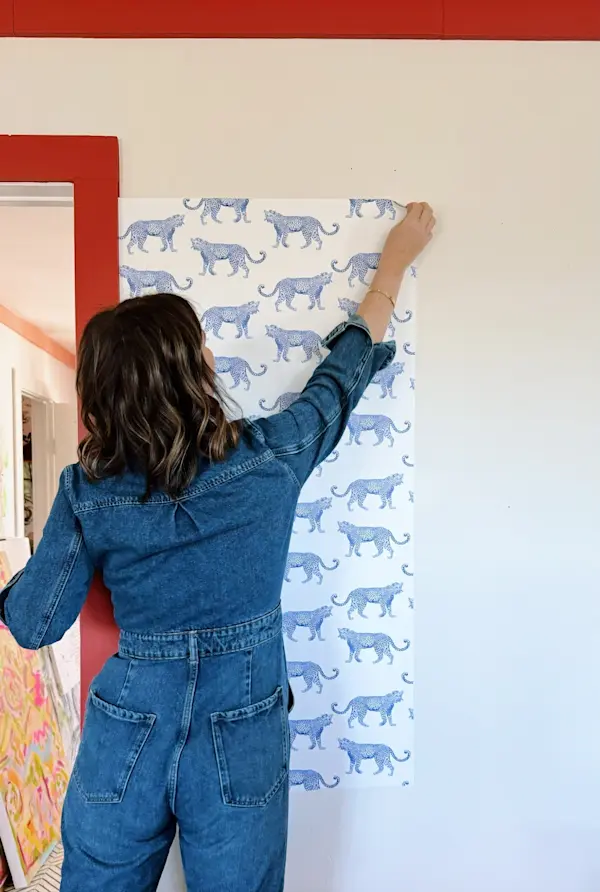
Peel-and-stick wallpaper requires no paste, soaking, or professional help. The adhesive backing applies directly to a clean, smooth wall and repositions easily during installation. It’s a straightforward Saturday project that delivers a result far more polished than the effort it requires.
It Comes Down Without The Damage
When it is time to move out or simply try something new, removable wallpaper peels away without damaging the wall beneath. This makes it particularly valuable in bathrooms, where landlords tend to scrutinize finishes closely. You get the design freedom of a homeowner without the long-term obligation.
Samples Let You Test Before You Commit
We offer small samples so you can see the print, scale, and color in your actual space before ordering. Your first 3 small samples are free with code SAMPLES, then $5 small and $20 large, which makes choosing the right pattern for your bathroom a far more confident decision.
Choosing The Right Print For Your Bathroom's Personality
Every bathroom has a character waiting to be drawn out, and the print you choose is what brings it to life. A well-chosen pattern can make a powder room feel like a destination, a guest bath feel considered, and a primary bathroom feel like a retreat. Here are some print directions worth considering.
Botanical And Nature-Inspired Prints
Florals, leaves, and organic motifs bring a sense of calm and freshness to the bathroom. They work especially well in spaces with natural light and pair beautifully with stone, wood, or neutral fixtures. Overall, nature prints feel timeless rather than trendy.
Toile And Scenic Prints
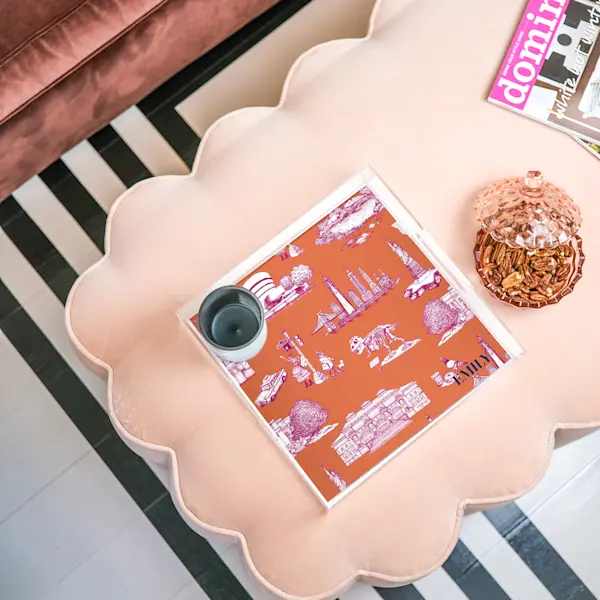
Toile patterns add a storytelling quality to any room they occupy. In a bathroom, they create an almost storybook atmosphere that’s rich in details and conversation-worthy. City toile wallpaper designs, in particular, give the space a distinct sense of place and personality.
Geometric And Graphic Prints
For bathrooms with a more modern or eclectic sensibility, bold geometric patterns deliver structure and energy. They pair well with minimalist fixtures and matte finishes. A strong graphic print can make even a small bathroom feel expansive and design-forward.
Two Bathroom Wallpaper Ideas Worth Considering
If you’re browsing and want a starting point, here are two prints that work particularly well in bathroom settings for very different reasons.
An Homage To Texas Roots
Pearl Snap is part of an exclusive Katie Kime collaboration with illustrator Kelly Colchin, whose hand-illustration work has a warmth and specificity that sets it apart from anything digitally generated. The print is a nod to worn-in denim, familiar rituals, and wide-open Texas spaces. It’s the kind of design that feels both personal and timeless. It comes in both peel-and-stick and traditional formats, and the peel and stick has a slight weave texture and matte finish that reads beautifully in a powder room. As an added bonus, it’s easy to clean with a damp cloth, removable, and doesn't require paste in the peel-and-stick format.
An Understated Floral Pick
Wildflower is also from the Kelly Colchin collaboration, this time rooted in her watercolor work and her love for the uniqueness of Texas landscapes. If you grew up anywhere near a Texas highway in spring, you know the particular joy of bluebonnets appearing seemingly overnight. That’s the feeling this print carries. The traditional format makes it a strong candidate for a powder room where you want something that will last. However, if you prefer a peel-and-stick version, that’s also available. Either way, the botanical detail rewards exactly the kind of close-up attention a bathroom invites
Both prints are available as samples, and it’s always worth snagging one before you finalize any bathroom wallpaper order. Seeing the scale, texture, and color in your space under your unique lighting changes everything.
Wallpaper For Bathroom Spaces: Small Room, Big Impact
A small bathroom isn’t a design limitation. Instead, you can view it as an opportunity to be bolder than you might dare anywhere else in the home. Because the square footage is limited, the wallpaper doesn’t need to cover much to make a dramatic statement. The right print can make a compact space feel like the most memorable room in the house.
Go Full Coverage In A Powder Room
Powder rooms are the ideal starting point for committing to a bold print. Since no one sleeps or spends hours in them, you can take more risks with stronger patterns. Covering all four walls with a vibrant pattern creates an immersive, jewel-box effect that guests will always remember.
Use An Accent Wall Strategically
In a larger bathroom, a single wallpapered wall behind the vanity or bathtub can anchor the whole room. It draws the eye immediately and gives the space a focal point without overwhelming it. The rest of the room can stay neutral and let the print lead.
Scale Your Print To The Room
Smaller rooms tend to work better with medium-scale prints rather than oversized patterns that can feel chaotic in tight spaces. A well-scaled repeat keeps the design feeling intentional and balanced rather than busy.
Installation Tips For Bathroom Wallpaper
Here are a few practical notes before anything goes up on the wall:
Pay Attention To Wall Prep
Walls should be clean, dry, smooth, and fully cured before installation. Make sure to thoroughly remove any old wallpaper, dust, grease, or flaking paint beforehand for the smoothest application. For traditional wallpaper, prime the walls first. Katie Kime recommends Roman PRO-977 ULTRA-PRIME® for drywall. If you’ve just painted your walls, wait at least four to six weeks after painting before applying, and test adhesion with clear tape first if you are unsure about the surface.
Temperature And Humidity
Maintain the room above 65°F for at least 48 hours before and after traditional wallpaper installation. In addition, let the wallpaper acclimate to the room for 48 hours prior to hanging. The walls should be completely dry (no more than 4% residual moisture) before you install. From there, keep the room ventilated during and after installation to support proper drying.
Inspect Before You Begin
Katie Kime wallpaper is printed to order, and defects found after installation cannot be addressed once hanging has started. We highly recommend laying out all the panels before touching the walls, checking for any inconsistencies, and contacting customer service immediately if something looks off.